Home entertainment changed faster than any other living-room technology over the last twelve months. If you were comparing IPTV vs cable TV in 2025, the conversation has already shifted. In 2026, bandwidth, pricing, and channel access all tilted toward IPTV, but cable still hangs on thanks to reliability and legacy bundles. This 1,800-word breakdown walks you through every factor so you can decide which platform deserves your next subscription.

📋 Table of Contents
- 1. IPTV vs cable TV in 2026: entertainment landscape at a glance
- 2. How modern IPTV delivers channels
- 3. Where cable TV still competes
- 4. Head-to-head feature comparison
- 5. Real 2026 cost breakdown
- 6. Picture quality, latency, and reliability
- 7. Device + installation experience
- 8. Best-fit scenarios for each platform
- 9. Checklist to choose your winner
- 10. Next steps + free IPTV trial
1. IPTV vs cable TV in 2026: entertainment landscape at a glance
Broadband capacity finally caught up to 4K streaming. Ookla’s Global Index shows the average fixed-line household cruising at 118 Mbps, which easily supports four simultaneous Ultra HD streams. Cable companies, meanwhile, continued to raise rates—US households paid an average of $124 per month for linear TV in January 2026. The combination pushed millions of homes to evaluate IPTV for the first time.
- 200M+ households worldwide now use IPTV as their primary TV source, according to the Deloitte Digital Media Trends 2026 report.
- 37% of US homes cut the cord entirely in the past 24 months.
- 4K/60 sports streams became the default offering for top IPTV providers.
- ISP bundles still lock 28% of viewers into cable because of promotional pricing.
Start free trial →
2. How modern IPTV delivers channels
IPTV (Internet Protocol Television) delivers live channels, catch-up TV, and on-demand movies over the same fiber or cable line that powers your Wi-Fi. Streams route through Content Delivery Networks so the signal originates from a server close to your home. That proximity slashes latency and keeps 4K sports smooth even on busy nights.
Core benefits
- Watch on Smart TVs, phones, tablets, browsers
- Pause, rewind, or record live channels
- Choose from 20K–25K verified live channels
Requirements
- Stable 25 Mbps+ connection for 4K
- Supported player (IPTV Smarters, TiviMate, etc.)
- Reliable provider with redundant servers
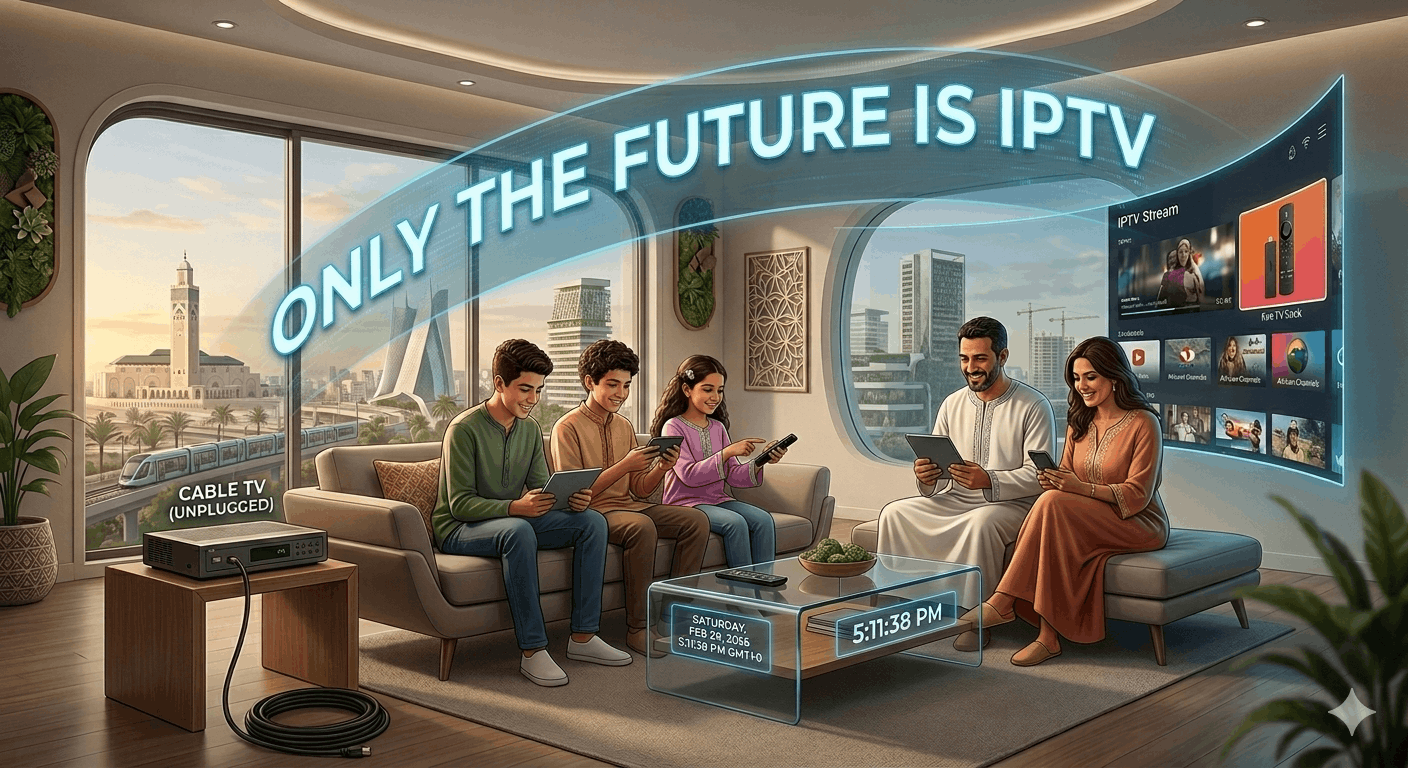
Top-tier providers such as 4K Live IPTV layer on advanced EPG data, multi-screen viewing, and instant channel switching. Because everything rides on your broadband connection, quality scales with the hardware you already pay for.
3. Where cable TV still competes
Cable TV relies on coaxial infrastructure with dedicated spectrum for television. Signals stay isolated from your internet traffic, so congestion is almost nonexistent. Providers bundle set-top boxes, DVRs, and premium add-ons in one invoice, which appeals to viewers who prefer a traditional setup.
Drawbacks remain familiar: long contracts, equipment rental fees, and limited device flexibility. Watching outside the living room typically requires clunky apps or additional hardware.
4. Head-to-head feature comparison
| Capability | IPTV (2026) | Cable TV (2026) |
|---|---|---|
| Live channel count | 20K–25K global channels | 200–400 regional channels |
| On-demand library | 100K+ movies/series updated weekly | Limited VOD, pay-per-view |
| Multi-device viewing | Unlimited screens with login | Mostly tied to set-top boxes |
| 4K availability | Standard on sports + movies | Premium add-on tiers only |
| Mobility | Watch anywhere with internet | Restricted to service address |
| Setup speed | Same-day activation via email | Installer visit + hardware rentals |
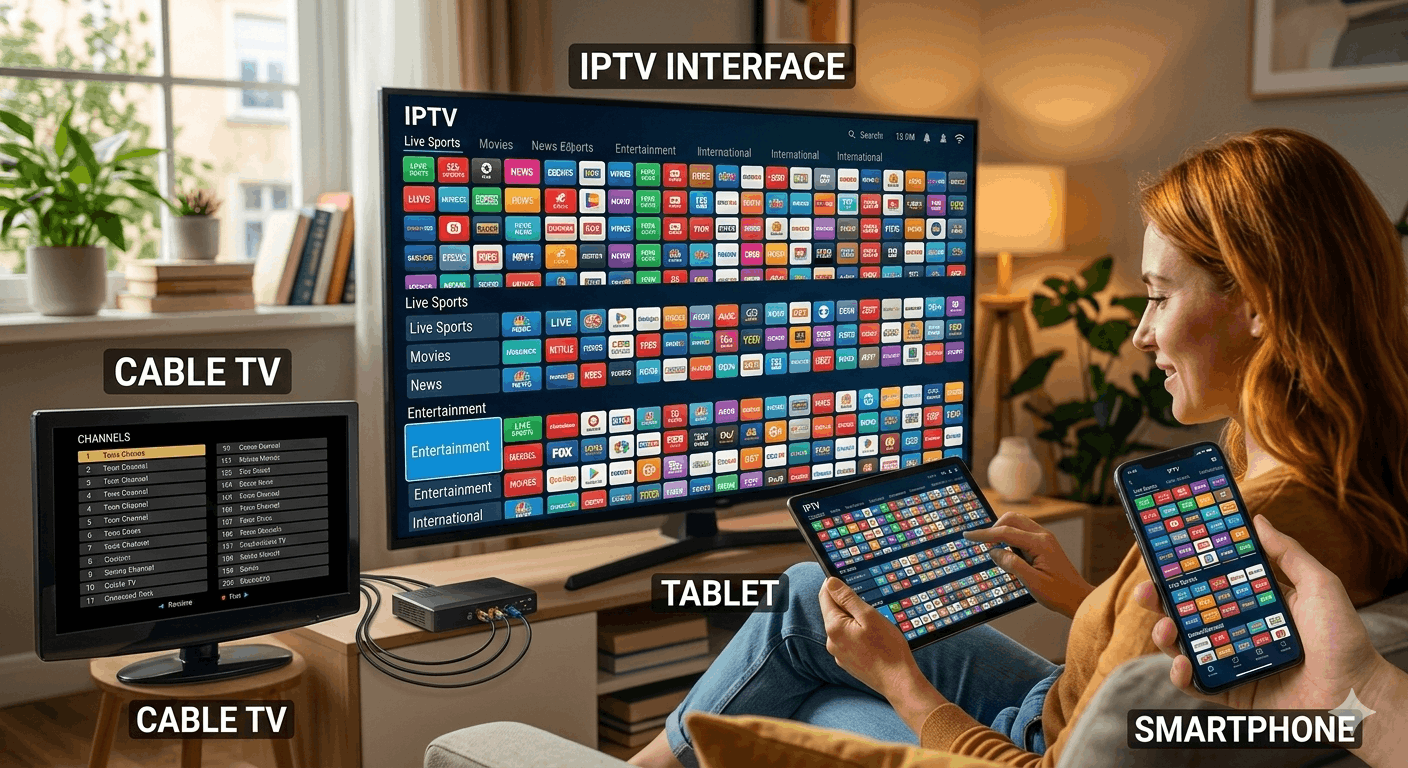
For power users who bounce between a living-room TV, a tablet in the kitchen, and a phone on the train, IPTV’s device freedom is a decisive advantage.
5. Real 2026 cost breakdown
Pricing varies wildly between providers, so we modeled apples-to-apples plans built around 4K sports, premium movies, and 3–4 simultaneous viewers.
- IPTV scenario: $25/month (annual plan) for 25K channels + 100K VOD, no equipment fees, no contract.
- Cable scenario: $124/month after promo for 220 channels, plus $15 DVR rental, plus $12 regional sports fee.
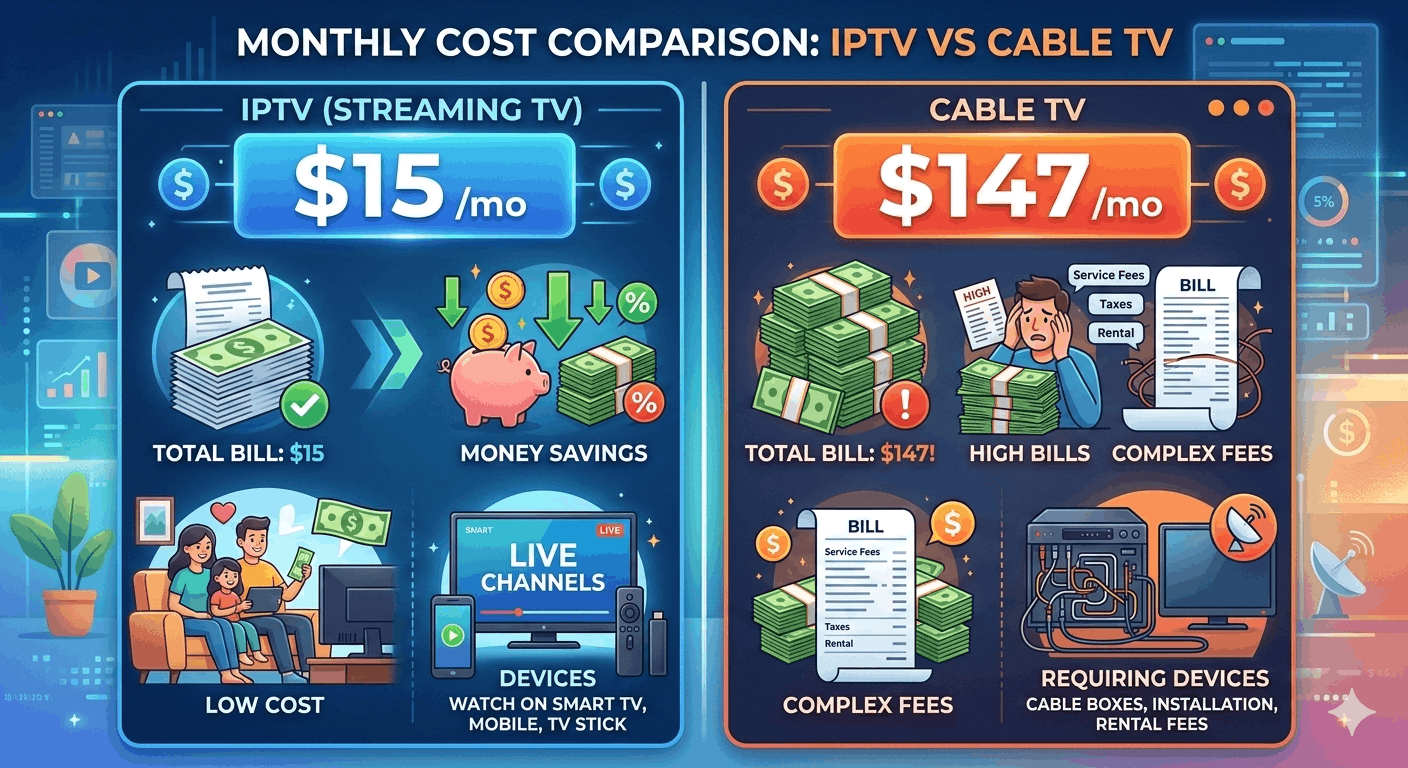
Over the first year, IPTV totals $300. Cable crosses $1,800 before taxes. Even if you add a $15/month premium VPN or whole-home Wi-Fi upgrade for IPTV, you still save roughly $1,300.
6. Picture quality, latency, and reliability
IPTV quality depends on your network. When the connection is wired or Wi-Fi 6, 4K streams run at 15–25 Mbps with HDR and 60 fps motion. Buffering only appears when the household saturates the network with simultaneous downloads.
- Sports latency: IPTV trails live stadium feeds by 15–20 seconds; cable is closer to 5–7 seconds.
- HDR tone mapping: IPTV services now support HDR10/HLG across major sports channels; cable HDR is limited to select events.
- Availability: Cable keeps working during home modem reboots. IPTV pauses until the router is back online.
The practical fix is simple: run your primary IPTV device via Ethernet or a dedicated Wi-Fi 6 mesh node, and enable QoS to prioritize streaming traffic.
Looking ahead, ISPs are rolling out Wi-Fi 7 gateways and multi-gig fiber tiers that push 2–5 Gbps to the home. IPTV providers already test 8K and 120 fps sports feeds on those lines, while cable ecosystems remain capped by DOCSIS 3.1 spectrum. If you value future-proofing, IPTV maps cleanly onto that roadmap—especially if you plan to add mixed-reality headsets or secondary 4K projectors over the next two years. The FCC broadband guide is a great benchmark for understanding whether your home can sustain the bandwidth required for IPTV vs cable TV in 2026 streaming.
7. Device and installation experience
With IPTV, installation equals “enter credentials.” Load IPTV Smarters Pro on a Firestick or TiviMate on Google TV, paste your Xtream Codes login, and start streaming. You can clone the playlist to every device in the house in under 10 minutes.
Cable requires technician visits, coax drops in each room, and separate DVR units for extra TVs. Remote viewing depends on proprietary apps that often limit resolution or block certain channels outside your home network.
See IPTV plans →
8. Best-fit scenarios for each platform
Choose IPTV when…
- You want every sport + international channel in one app
- Your home internet is 200 Mbps fiber or cable
- You dislike contracts and equipment rentals
- You stream on travel, RV trips, or between homes
Stay with cable when…
- You experience frequent broadband outages
- You live in a rural area with sub-25 Mbps speeds
- You rely on niche regional sports nets not yet on IPTV
- You prefer a single installer-managed setup
Plenty of households run both for redundancy, but the majority who keep cable now do it for internet bundles rather than TV quality.
9. Checklist to choose your winner
- Test your speeds: Run an Ethernet and Wi-Fi test during prime time. If you clear 50 Mbps, IPTV is viable.
- Audit your must-have channels: List sports leagues, local news, and premium networks you actually watch.
- Calculate total ownership cost: Factor in modem/router upgrades versus cable equipment fees.
- Assess mobility needs: If you watch outside the living room, IPTV wins by default.
- Leverage trials: Stream a Champions League night on IPTV before cancelling cable to see if quality satisfies you.
Use this checklist as your quick-reference sheet whenever the question “Which wins in the IPTV vs cable TV in 2026 debate?” comes up inside your household.
10. Next steps + free IPTV trial
If you’re ready to experience IPTV, start with a 24-hour or 3-day trial from a provider that publishes real channel lists, offers 24/7 support, and backs every order with a money-back guarantee. Pair the test with a quick router tune-up—enable QoS, update firmware, and plug your primary streaming device into Ethernet.
Stream smarter tonight
4K Live IPTV delivers 25,000+ live channels, 100,000 VOD titles, HDR sports, and instant activation. No contracts. No installer.
Whether you ultimately stick with cable or cut the cord entirely, the 2026 market finally gives you leverage. Test both sides, compare the experience in your own living room, and lock in the platform that gives you the best mix of cost, quality, and convenience.